Chapter 29
Gulf Coast heat on attic water heaters and pipes
The questionIs it safe to keep a water heater in a hot Texas attic, and what does it need?
The short answerAttic water heaters on the Gulf Coast need a metal drain pan piped to a real drain and venting their manual allows in high heat, because makers say every tank leaks eventually and attics run hot.
By the editors of High Water at Home · Updated · about 8 minutes
Sections in this chapter
- 29.1 Should a water heater be in the attic at all?
- 29.2 What does the drain pan have to be?
- 29.3 How hot is too hot for the venting?
- 29.4 Does a heat pump water heater belong in an attic?
- 29.5 Can PEX and CPVC lines handle attic heat?
- 29.6 What temperature should the tank be set to?
- 29.7 Why does only the hot water smell like rotten eggs?
29.1 Should a water heater be in the attic at all?
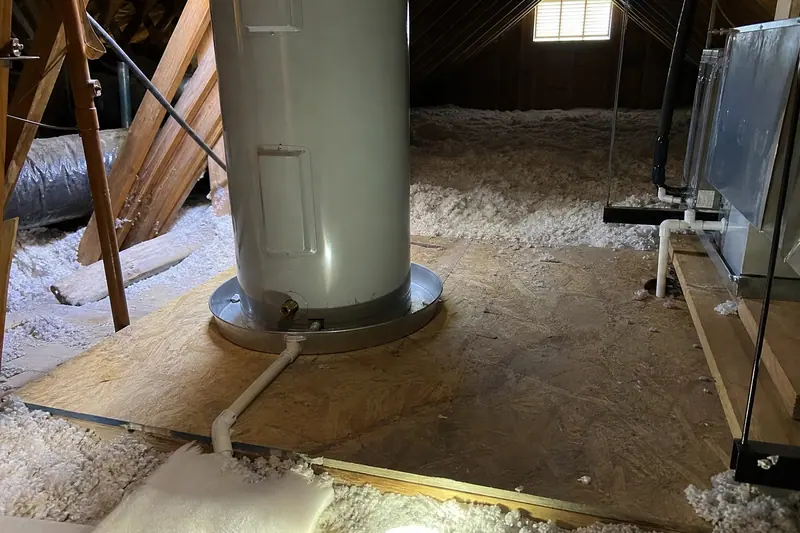
Makers are cautious about it. A. O. Smith's installation manual for its residential power-vent gas heaters (March 2021) says it is not advisable to put a water heater in an attic or on an upper floor, and that a metal drain pan should go under it in all cases. The same manual says, plainly, that all water heaters eventually leak.
Flood country pulls the other way. FEMA's 2023 flood protection brochure tells owners of flood-prone houses to raise water heaters a foot or more over the BFE on masonry, concrete or treated lumber, and for a slab-on-grade home the attic is one way up. FEMA's homeowner's guide to retrofitting notes that gas heaters are harder to move because of their venting, and says that when a heater goes up there, the drain pan and its piping have to be thought through so a leak does not spill into the rooms below. If yours went under water instead, see water heaters that went under water.
29.2 What does the drain pan have to be?
Metal, slightly larger than the tank, and piped to a drain. The A. O. Smith manual calls for a pan at least 1 inch wider than the heater jacket on every side, no deeper than 1.75 inches, piped to an adequate drain. Other models and makers may set different numbers, so read the manual for the heater you have.
The code side is set by the state and your city. The Plumbing Board's rules, compiled March 2026, adopt the 2018 Uniform Plumbing Code and 2018 International Plumbing Code; a Texas Register proposal of 14 August 2026 would move to the 2021 editions, and we saw no notice of adoption as of 11 Nov 2026. The City of Wharton builds to the 2018 IPC with amendments. Ask the plumber which pan rule applies where you live.
The same manual adds that a leak detector or automatic water shutoff, used with a piped metal pan, can reduce or prevent damage. It lists types: sensors in the pan, whole-house shutoffs and pressure-differential shutoffs. Whatever you fit, learn where the main water valve is; the chapter on shutting off water shows how to find it.
| Item | What the source says | Source |
|---|---|---|
| Drain pan | Metal, at least 1 in larger than the jacket all round, no deeper than 1.75 in, piped to a drain | A. O. Smith power-vent gas manual, March 2021 |
| Leak sensor or auto shutoff | Can reduce damage when used with a piped metal pan | Same manual |
| Venting in high heat | Spaces above 110°F need the special vent material that model's manual names | Same manual |
| Tank thermostat | 120°F, considered safe for most people | DOE Energy Saver guide, 2022 |
| Heat pump water heater location | Interior space that stays 40°F to 90°F all year, with 1,000 cubic feet of air | ENERGY STAR |
| PEX tubing (one maker) | Hot water service no hotter than 140°F at 80 psi | Maker's submittal, ASTM F2023 |
| CPVC pipe (one maker) | Rated 100 psi at 180°F | Maker's installation guide, ASTM D2846 |
29.3 How hot is too hot for the venting?
For at least one heater, 110°F. The A. O. Smith power-vent manual says installations where the surrounding air tops 110°F need a special vent material, and it names attics, "especially in metal roofed buildings," among the high-heat spaces, along with closets and alcoves. It also says to keep the heater out of direct sunlight.
That rule belongs to that model. Other heaters vent in other ways, so the manual on the side of your tank is the one to follow.
29.4 Does a heat pump water heater belong in an attic?
Check the space against ENERGY STAR's range first. ENERGY STAR's heat pump water heater page says these units should go in interior spaces that stay between 40°F and 90°F year-round with 1,000 cubic feet of air around them, and that in hot, humid months they can help cool and dry the space.
The page does not mention attics by name. Before choosing one for an attic in Boling or East Bernard, find out whether that attic stays inside the range in August.
29.5 Can PEX and CPVC lines handle attic heat?
Within their ratings, which differ by product. One PEX maker's submittal for white PEX coils gives 160 psi at 73°F, 100 psi at 180°F and 80 psi at 200°F, and says domestic hot water should not run above 140°F at 80 psi under ASTM F2023. One CPVC maker's installation guide rates its pipe at 100 psi continuous at 180°F, and 400 psi at 73°F.
The CPVC guide adds two warnings that matter in a hot roof space: the pipe grows about 4 inches per 100 feet for a 100°F temperature change, and long exposure to sunlight is not advised. Other brands differ, so look at the marking printed on your pipe. Cold lines that run through a hot attic will also carry warm water to the tap in July; insulation helps, which is the same wrap described for freezes in the February 2021 freeze chapter.
29.6 What temperature should the tank be set to?
The Department of Energy suggests 120°F. Its Energy Saver guide (2022) calls that safe for most of the population and says water heating is about 18% of a home's energy use. It estimates that insulating a warm storage tank saves 7% to 16% a year on water heating, and insulating hot pipes 3% to 4%.
The same guide suggests draining a quart from the tank every 3 months to clear sediment, following the maker's directions. Hard Gulf Coast groundwater leaves scale in heaters, so that habit matters here; see hard water and iron.
29.7 Why does only the hot water smell like rotten eggs?
The tank is the usual source. The Texas Well Owner Network says a rotten-egg smell from hot taps but not cold ones likely comes from the water heater, where a magnesium anode rod reacts with sulfate. A licensed plumber can fit a zinc anode, though TWON notes that may void the warranty. Bacteria also do well in warm tanks such as water heaters and softeners.
Questions readers ask
Where should an attic drain pan's pipe end?
The manual cited here says only that it must go to an adequate drain, and the code adopted where you live sets the rest. A licensed plumber can show you where yours runs, so you will know where to look for drips.
Does a drain pan stop all leak damage?
No. A pan catches drips and slow leaks; a burst tank can overrun it. The A. O. Smith manual pairs the pan with leak sensors or an automatic shutoff for that reason.
Is 140°F too hot for a tank in the attic?
DOE suggests 120°F for most homes. Above that, check the hot-water rating printed on your pipe; one PEX maker caps hot-water service at 140°F at 80 psi.
Can a homeowner move a water heater into the attic alone?
Moving a heater means new water, drain and gas or electric work, and inside the City of Wharton that needs a permit and a licensed plumber. Gas venting adds a carbon monoxide risk that is not a job to guess at.
Why does my cold water run warm in summer?
A cold line that passes through a hot attic picks up heat before it reaches the tap. Running it a moment clears the warm water, and pipe insulation slows the heating.
What this chapter rests on
This chapter is built on one A. O. Smith installation manual (March 2021), DOE's 2022 Energy Saver guide, ENERGY STAR's heat pump page, one PEX and one CPVC maker's ratings, the Plumbing Board's March 2026 rules and the August 2026 Texas Register, all checked on 11 Nov 2026. This book could not confirm the current code text on drain pans, so no section number is printed; ask the City of Wharton or county permit office; ratings for other heater models and pipe brands are left out.
Notes to chapter 29
- A. O. Smith — Residential Gas Water Heaters, Installation Instruction and Use & Care Guide (March 2021) · attic caution, drain pan size, leak devices, 110°F venting · checked 11 Nov 2026
- FEMA — Homeowner's Guide to Retrofitting, P-312 (June 2014) · drain pans and piping for raised heaters; venting makes gas heaters harder to move · checked 11 Nov 2026
- FEMA — Protect Your Property From Flooding (2023) · water heaters at least 12 inches above the BFE · checked 11 Nov 2026
- Texas State Board of Plumbing Examiners — Administrative Rules (March 2026) · 2018 UPC and IPC adopted · checked 11 Nov 2026
- Texas Register — Proposed Rules, Title 22, 14 August 2026 · proposed move to 2021 codes · checked 11 Nov 2026
- City of Wharton — Building Permits & Inspections · 2018 IPC with amendments; permits · checked 11 Nov 2026
- US DOE — Energy Saver guide (2022) · 120°F setting, insulation savings, sediment draining, 18% figure · checked 11 Nov 2026
- ENERGY STAR — Heat Pump Water Heaters · 40°F to 90°F space, 1,000 cubic feet · checked 11 Nov 2026
- PEX tubing maker — submittal for white PEX coils · pressure-temperature ratings, 140°F at 80 psi · checked 11 Nov 2026
- CPVC pipe maker — hot and cold water installation guide · 100 psi at 180°F, expansion, sunlight · checked 11 Nov 2026
- CDC — Carbon Monoxide Poisoning Basics · vent slope, yearly servicing · checked 11 Nov 2026
- Texas A&M AgriLife Extension / Texas Well Owner Network — Well Owner's Guide to Water Supply, ESC-029 · hot-tap odor, anode swap, bacteria in warm tanks · checked 11 Nov 2026