Chapter 17
Gas lines and propane tanks after a flood
The questionIs my gas line or propane tank safe after floodwater went through?
The short answerGas lines and propane tanks that sat in floodwater are not yours to test or restart: if you smell gas, get out, call from outside, and let the gas utility or your propane supplier check every line, regulator and tank.
By the editors of High Water at Home · Updated · about 8 minutes
Sections in this chapter
- 17.1 What does floodwater do to gas lines and propane tanks?
- 17.2 Who supplies the gas in your part of Wharton County?
- 17.3 What should you do if you smell gas?
- 17.4 What if your propane tank moved, floated or tipped?
- 17.5 Can you use gas appliances that sat in water?
- 17.6 Who turns the gas back on, and who can touch the meter?
- 17.7 How can you keep a propane tank in place next time?
17.1 What does floodwater do to gas lines and propane tanks?
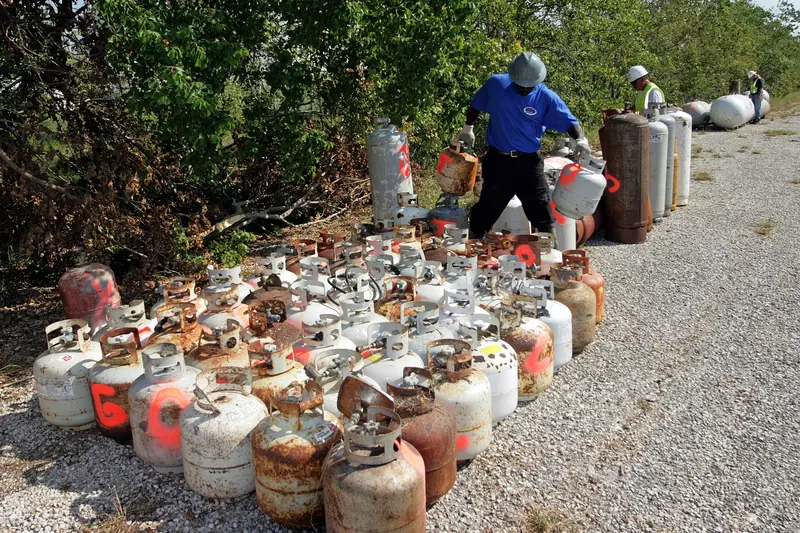
Floodwater pushes on anything that holds air or gas, and a propane tank is a sealed shell. FEMA's guide to protecting utilities says that buoyant forces can crush or displace fuel tanks, and that a tank that shifts can tear its fuel line and let fuel escape. The same 2017 guide warns that water can put out standing pilot lights on natural gas and propane appliances, which it counts as a fire risk.
The damage does not stop when the water leaves. FEMA's guide notes that corrosion keeps damaging equipment after floodwater recedes, and silt does the same to regulators, valves and appliance controls. A line that looks fine from the yard can be bent or cracked where it enters the house or the tank.
17.2 Who supplies the gas in your part of Wharton County?
If your house in Wharton or El Campo has piped natural gas, the utility is most likely CenterPoint Energy. The CenterPoint Energy Entex tariff on file with the Railroad Commission of Texas, effective 6/2/2026, lists Wharton and El Campo among its delivery points.
Out in rice country, around Glen Flora, Louise, Boling and the farm roads along the San Bernard, many houses run on propane from a tank in the yard. Your bill tells you which one you have. If you have a propane tank, the company that fills it is your first call for anything about the tank, the regulator or the lines. The Railroad Commission regulates the storage and use of LP-gas in Texas.
17.3 What should you do if you smell gas?
Leave first, then call. The Railroad Commission says propane is odorized to smell like rotten eggs; treat any gas smell the same way. If you notice one anywhere in or near the house, do not flip a switch, use a phone, light a match or start an engine inside. The Consumer Product Safety Commission put it plainly in its August 2021 hurricane release: leave your home and contact the gas authorities from outside.
- Get everyone, pets included, out of the house and well away from it.
- From outside, call 911.
- Then call CenterPoint Energy if you are on natural gas, or your propane supplier if you are on a tank.
- Stay out until the utility, supplier or fire department tells you the house is safe.
17.4 What if your propane tank moved, floated or tipped?
Stay away from it. A tank that has shifted can have a broken line, a damaged valve or a regulator full of silt. Do not push it upright, drag it back to its pad or open anything on it. Tell your propane supplier where it is, and call 911 or the fire department too, all the more if it smells, hisses, or sits in a road, ditch or someone else's yard.
The Railroad Commission's propane safety brochure lists the times to call your dealer or a qualified technician after a storm. Table 17.1 sets them out with the right person for each.
| What you find | What you do | Who checks it |
|---|---|---|
| Smell of gas, in town | Leave, call from outside | 911, then CenterPoint Energy |
| Smell of propane on a rural lot | Leave, call from outside | 911 or fire department, then your propane supplier |
| Tank shifted, floated or tipped | Keep away, do not move it | Propane supplier, and 911 or fire department |
| Regulator was under water | Leave the system alone | Propane dealer or qualified technician |
| Gas lines look bent or broken | Keep away from them | Gas utility or propane supplier |
| Gas appliance or its controls got wet | Do not use or light it | Qualified gas appliance technician or licensed plumber |
The same brochure says never to modify or repair your propane system yourself, and not to put back into use anything a technician has tagged out of service. It also says Texas requires propane companies to run a leak test before they refill an empty tank, so a tank that ran dry during the storm gets checked before it is filled again.
17.5 Can you use gas appliances that sat in water?
No. Any gas water heater, furnace, range or dryer that was under water stays off until a qualified technician has looked at it. The Railroad Commission says a flooded gas control must be replaced by a qualified gas appliance technician. A 1997 CPSC warning to flood victims, still posted on its site, says gas control valves that were under water cannot be salvaged.
No one in the household lights a pilot the water put out, even once things look dry; only the technician or the gas utility restores service and lights it. Water heaters have their own chapter, Water heaters that went under water, because the makers publish flood statements of their own. Electric appliances and the panel have theirs in Power stays off.
17.6 Who turns the gas back on, and who can touch the meter?
Only the utility or a qualified professional. Ready.gov's safety skills page says that once gas has been turned off for any reason, only a qualified professional can turn it back on, and never to try it yourself. That holds whether the utility shut it, a neighbor did, or you found it off when you came home.
Meters usually belong to the gas company. FEMA's homeowner retrofitting guide notes that you may not be allowed to move or raise a meter without the utility's permission. Inside the City of Wharton, repairs to house gas piping go through the Code Enforcement Department, which has adopted the 2018 International Fuel Gas Code with amendments, as the city's permit page read on 11 Nov 2026. What to do while the water is still rising is in the shutoff chapter.
17.7 How can you keep a propane tank in place next time?
Anchoring is the usual answer, and your supplier does it or approves it. FEMA's 2023 brochure, Protect Your Property From Flooding, says to anchor fuel tanks to the pad so they cannot tip or float, and to keep vents and fill openings above the base flood elevation. It notes you may need the fuel provider's permission.
FEMA's retrofitting guide adds two details for tanks below flood level: anchors should be designed as if the tank were empty, and the line to the house needs a flexible connection. To learn how high that is on your lot, start with the chapter on FEMA maps.
Questions readers ask
Can the tank valve go back on once the water has gone down?
No. The Railroad Commission tells owners never to modify or repair a propane system. Call your supplier, who will check the tank, regulator and lines and decide when gas can flow again.
Will my propane company refill a tank that ran empty in the storm?
Yes, but not without checking it. Texas requires propane companies to perform a leak test before refilling an empty tank, as the Railroad Commission's brochure states.
What if a stranger's tank washed into the yard?
Keep people and pets away from it. Call 911 or the fire department, and tell them where it sits. Do not try to move it, read its fittings up close or open it.
My generator is near the propane tank. Is that a problem?
Keep the generator outdoors and more than 20 feet from doors, windows and vents, as CDC advises, and never run it in a garage, carport, porch or crawl space. Ask your propane supplier about distance from the tank. Generators, well pumps and the transfer switch covers the rest.
Does flood insurance pay for a damaged propane tank?
Fuel tanks appear on the Dwelling Form's short list of things insured under a raised house, in the version FEMA posted when we checked on 11 Nov 2026. Your adjuster decides each claim; Flood insurance and plumbing damage explains the policy in more detail.
What this chapter rests on
This chapter rests on the Railroad Commission of Texas propane brochure and gas tariff filing, FEMA's utility and retrofitting guides, two CPSC releases, Ready.gov and the City of Wharton's permit page, all checked on 11 Nov 2026. Where some agency pamphlets ask households to operate gas valves, those parts are not followed here. This book could not confirm who supplies gas on each rural road, because the tariff lists city delivery points only; ask your propane supplier or CenterPoint Energy.
Notes to chapter 17
- Railroad Commission of Texas — Propane Safety Tips for the Home · smell, low spots, who to call after a flood, leak test before refill, no owner repairs, flooded gas controls · checked 11 Nov 2026
- Railroad Commission of Texas — CenterPoint Energy Entex gas tariff gftr0049b_6263 · Wharton and El Campo delivery points, effective 6/2/2026 · checked 11 Nov 2026
- Railroad Commission of Texas — Alternative Fuels · RRC regulates LP-gas storage and use · checked 11 Nov 2026
- FEMA — P-348, Protecting Building Utility Systems From Flood Damage (2017) · buoyant tanks, broken fuel lines, pilot lights put out by floodwater · checked 11 Nov 2026
- FEMA — Protect Your Property From Flooding (2023) · anchoring fuel tanks, vents above BFE · checked 11 Nov 2026
- FEMA — P-312, Homeowner's Guide to Retrofitting (2014) · meters belong to the utility, empty-tank anchoring, flexible connections · checked 11 Nov 2026
- CPSC — Protect Your Family Before and After Hurricane Ida (2021) · leave and call from outside if you smell gas · checked 11 Nov 2026
- CPSC — Warning to Flood Victims (1997) · gas control valves under water must be replaced · checked 11 Nov 2026
- Ready.gov — Safety Skills · only a qualified professional turns gas back on · checked 11 Nov 2026
- City of Wharton — Building Permits & Inspections · 2018 International Fuel Gas Code adopted, permits through Code Enforcement · checked 11 Nov 2026
- CDC — Carbon Monoxide Poisoning Basics · generators outdoors, 20 feet from openings · checked 11 Nov 2026
- FEMA — NFIP Dwelling Form F-122 (2021) · fuel tanks on the list covered below elevated floors · checked 11 Nov 2026