Chapter 22
Testing well water after a flood
The questionWhen and how should I test my well water after a flood, and for what?
The short answerTesting well water after a flood means a bacteria test by a TCEQ-accredited lab, taken 7 to 10 days after the well is disinfected, followed by repeat tests over the next months before you trust the water again.
By the editors of High Water at Home · Updated · about 7 minutes
Sections in this chapter
22.1 When should you test a well after a flood?
After the well has been disinfected and the chlorine is gone. In guidance updated in May 2025, CDC puts the gap between disinfecting and sampling at no less than a week to 10 days, long enough for the chlorine to be flushed from the pipes.
The EPA gives the same 7-to-10-day window in its flood guidance for well owners, updated October 2024. Until a clean result comes back, keep using bottled water, or water held at a rolling boil for at least 1 minute. The disinfection itself is covered in Disinfecting a flooded well.
22.2 What should the lab test for?
Bacteria first, then a few basics. The core flood test is total coliform plus E. coli or fecal coliform, as CDC lists it. AgriLife's Water Well Basics, dated May 2023, says every well should be tested at least yearly for nitrate, total dissolved solids, and E. coli or fecal coliform. The EPA's own yearly list for private wells also includes nitrate, so it is worth adding to the first test after a flood.
| Test | Why it matters after a flood | Benchmark |
|---|---|---|
| Total coliform | Core bacteria test after a flood (CDC) | Goal is zero (TWON) |
| E. coli or fecal coliform | Tested with total coliform (CDC) | Goal is zero (TWON) |
| Nitrate (as nitrogen) | On AgriLife's and EPA's yearly lists; infants most at risk | 10 mg/L EPA limit for public water |
| Total dissolved solids | On AgriLife's and EPA's yearly lists | Part of AgriLife's yearly test |
The EPA's nitrate limit of 10 mg/L, listed on its drinking water regulations page as updated 31 Aug 2026, legally applies to public systems; for a private well it is a benchmark. EPA says infants under 6 months who drink water over that level could become seriously ill, so households with a baby should take a nitrate result seriously.
22.3 How do you find an accredited lab?
Use TCEQ's database. Labs that produce drinking water data under the Safe Drinking Water Act must be accredited by TCEQ, a rule in place since July 1, 2008. TCEQ's laboratory accreditation page links to a public database you can search by test, such as "coli" for E. coli, and by matrix, such as drinking water. Since January 31, 2020, labs have been assessed against the 2016 TNI NELAP standard.
Call the lab before you sample. Ask for its sterile bottles, its sampling instructions, the days it accepts bacteria samples and how fast it needs them. Some county health departments and hospitals have tested water in the past, AgriLife noted in 2006, but check what is offered near Wharton today.
22.4 How do you take a bacteria sample?
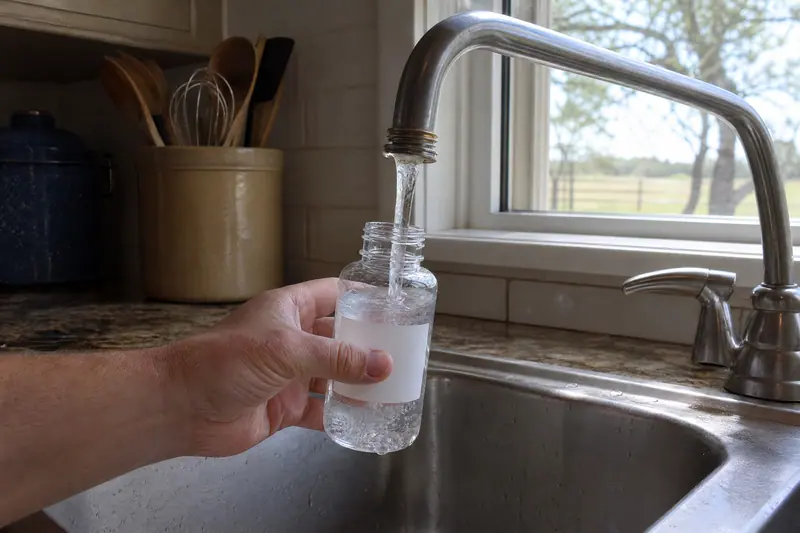
Carefully, with the lab's own bottle. AgriLife's sampling guide gives these steps:
- Get a sterile sample bottle from the lab, with its instructions.
- Pick a cold-water faucet, not a hose bib, a mixing faucet or a tap fed through a softener or filter.
- Take off the aerator.
- Run the cold water for 5 minutes.
- Fill and close the bottle the way the lab's instructions say.
- Keep it cool and get it to the lab within 6 hours if you can, and no more than 30 hours.
The same guide warns that many labs will not take bacteria samples on Fridays. Plan the trip for early in the week. If the well's wiring or wellhead is still waiting for a contractor, sample from a house tap only after the pump has been cleared to run, for the reasons in the well pump chapter.
22.5 What do the results mean?
Any coliform at all means the water is not yet safe. The Texas Well Owner Network's FAQ says the goal for coliform bacteria, including E. coli, in drinking water is zero. CDC says that if results show any coliform, repeat the disinfection and test again, and if bacteria keep turning up, contact the local health department.
AgriLife's 2023 guide on coliform in well water gives the order: resample for fecal coliform or E. coli, drink bottled water in the meantime, find and fix the cause, shock-chlorinate the well, preferably through a licensed driller or pump installer, then retest. A flooded septic system near the well is one cause to rule out; see A flooded septic system.
22.6 How often should you test after the first clean result?
More than once. CDC says to follow a clean result with another test in 2 to 4 weeks and another in 3 to 4 months, then keep checking bacteria at least twice a year. The EPA warns that after a flood a well may not be a safe source of water for many months, even after one good test.
After that first year, AgriLife's general advice is a test at least every year, plus a test after any pump or well work and after any change in color, taste or smell. A 2019 TWON guide also suggests a broader baseline test of hardness, iron and other minerals; Hard water and iron covers what those numbers mean.
22.7 Is a free screening the same as a lab test?
No. The Texas Well Owner Network holds screening events that check nitrate, total dissolved solids and whether coliform and E. coli are present. Its July 2025 sample instructions ask for samples taken within 24 hours of the event and kept cool. A screening is useful for a quick look, but it is not a test by an accredited lab. On 11 Nov 2026 the network's pages showed no screening date for Wharton County.
Questions readers ask
Can the same bottle be used for bacteria and nitrate?
Ask the lab. Bacteria tests need a sterile bottle and fast delivery, while other tests may use different bottles. The lab's instructions decide.
The test came back clear. Can the bottled water go now?
Only once the lab reports no coliform and no E. coli, and keep to CDC's follow-up tests at 2–4 weeks and 3–4 months. If fuel or chemicals reached the well, ask the lab first.
Should the sample come from the outside spigot by the well?
No. AgriLife says to use an indoor cold-water faucet with the aerator removed, not a hose or a mixing faucet.
Does a softener change the bacteria result?
AgriLife says not to sample from a treated tap, so use a faucet that bypasses the softener or filter, or ask your plumber where one is.
Is a cheap home test kit good enough after a flood?
For a flooded well, the agencies point to an accredited lab's bacteria test. A home kit or a screening can flag a problem, but it does not replace that result.
What this chapter rests on
The schedule and methods here come from CDC's well disinfection page, the EPA's flood guidance and drinking water regulations, TCEQ's accreditation page, and a run of AgriLife and TWON guides dated 2001 through 2025, checked on 11 Nov 2026. Older AgriLife guides list lab prices from 2001 and 2006; they are out of date and not repeated. No lab is named here; TCEQ's accreditation listing is where to find one accredited for the test you need.
Notes to chapter 22
- CDC — How to Disinfect Wells After an Emergency · wait 7 to 10 days, what to test, follow-up schedule, repeat if coliform found · checked 11 Nov 2026
- US EPA — What to Do After the Flood (816-F-05-021) · test 7 to 10 days after disinfection, unsafe for many months · checked 11 Nov 2026
- US EPA — National Primary Drinking Water Regulations · nitrate limit 10 mg/L, infants under 6 months · checked 11 Nov 2026
- TCEQ — Environmental Laboratory Accreditation · accredited lab database, 2008 rule, 2016 TNI standard · checked 11 Nov 2026
- Texas A&M AgriLife Extension — Water Well Basics (2023) · yearly nitrate, TDS and bacteria tests · checked 11 Nov 2026
- Texas A&M AgriLife Extension — What to Do About Coliform Bacteria in Well Water (2023) · steps after a positive result · checked 11 Nov 2026
- Texas A&M AgriLife Extension — Sampling for Bacteria in Wells (2001) · sampling steps, 6 and 30 hour limits, Friday samples · checked 11 Nov 2026
- Texas Well Owner Network — Frequently Asked Questions · coliform goal of zero · checked 11 Nov 2026
- Texas Well Owner Network — Water Sample Information (2025) · what screenings check · checked 11 Nov 2026
- Texas A&M AgriLife Extension — ER-011, Decontaminating Flooded Wells (2006) · health departments and hospitals as past testers · checked 11 Nov 2026
- Texas A&M AgriLife Extension — Well Owner's Guide to Water Supply (2019) · baseline mineral testing · checked 11 Nov 2026