Chapter 23
A flooded septic system: what not to do
The questionWhat should I do, and not do, with my septic system after a flood?
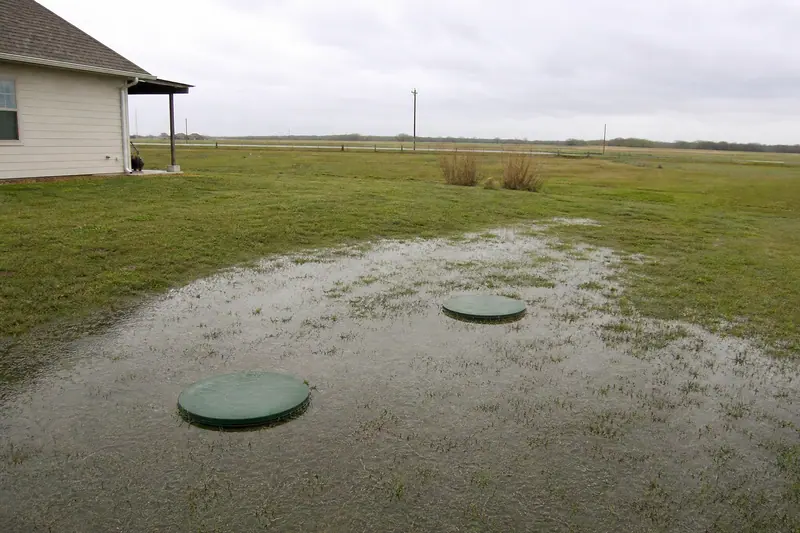
The short answerA flooded septic system should be used as little as possible and not pumped while the ground is soaked, because a tank emptied in saturated soil can float and break its pipes; licensed providers handle the tank and repairs.
By the editors of High Water at Home · Updated · about 8 minutes
Sections in this chapter
- 23.1 Why should you stop using a flooded septic system?
- 23.2 Should you have the tank pumped right away?
- 23.3 What should you never do around a flooded tank?
- 23.4 What changes if you have an aerobic system?
- 23.5 Who repairs a flooded system, and who issues permits?
- 23.6 What about sewage that backed up into the house?
23.1 Why should you stop using a flooded septic system?
Because it cannot treat anything until the ground drains. The EPA's septic flood guidance tells owners to hold off on using the system until the drainfield has drained below the water standing around the house. Its companion guidance for well owners puts it more simply: drainfields will not work until underground water has gone down, and septic lines may have broken in the flood.
Until then, every flush pushes water into a tank that has nowhere to send it. With groundwater this high, less water down the drains is the one defense against a backup that the EPA offers. Around Wharton, El Campo and the rice country south of US 59, that can take a while.
23.2 Should you have the tank pumped right away?
No, not while the ground is saturated. The EPA explains that pumping a tank in a flooded or soaked drainfield can make an emptied tank try to rise out of the wet soil and damage the pipes running in and out of it. AgriLife's guide to power outages and floods, from September 2008, agrees: after a flood, leave tanks at their usual operating level and do not pump them dry, since the soil around them is normally still soaked.
So the order is: cut water use, wait for the field to drain, then have a licensed provider look at the tank. Ask before you book a pump truck.
23.3 What should you never do around a flooded tank?
Never open a tank, enter it or lean into an opening. Septic tanks can hold dangerous gases, and the EPA leaves cleaning and repair to trained specialists. Its guidance also says to wait for dry soil before any digging near the tank or field, and to keep floodwater pumped out of the house away from the tank, where it would wash solids into the drainfield.
Keep vehicles off the drainfield too. Saturated soil compacts easily, the EPA warns, which can ruin the field's ability to treat wastewater. TCEQ's advice for septic owners puts vehicles over the system on its list of things not to do. That includes the truck you may be tempted to park on high ground in the yard.
23.4 What changes if you have an aerobic system?
Power and inspection come into it. Aerobic units, spray fields, drip lines and pump tanks run on electricity. AgriLife says that if floodwater covered above-ground parts such as air pumps or control panels, a service provider should inspect them before the system is used and before power goes back on. Where the water reached the tanks alone and none of the equipment above ground, AgriLife says a restart may go ahead without further checks once the field has drained.
The electrical side follows the same rule as the rest of the house. A control panel, timer, outlet or pump that sat in floodwater is left off until a licensed electrician has cleared it, and nobody reaches for a breaker while standing on wet ground; Power stays off covers why. AgriLife notes that a Texas system with powered parts must hold reserve capacity, about 80 gallons for a three-bedroom house in its 2008 figures, so a short outage gives some room if water use stays low.
Table 23.1 sets out the main differences.
| System | Needs power? | After the flood |
|---|---|---|
| Conventional tank and gravity drainfield | No | Use as little water as possible until the field drains; no pumping while soaked |
| Aerobic unit with spray heads | Yes | Service provider inspects flooded air pump and panel before power returns; limit use of the spray area for a day or two |
| Pump tank, low-pressure or drip field | Yes | Provider checks the pump and controls; call if the high-water alarm stays on more than 24 hours |
| Any system with silt in the tanks | Varies | Professional cleaning; a silt-clogged field may need replacing (EPA) |
One warning from TCEQ's maintenance page, last modified 3 Mar 2026: never use swimming pool chlorine tablets in an aerobic system's disinfection unit. Use the calcium hypochlorite tablets made for wastewater.
23.5 Who repairs a flooded system, and who issues permits?
State-licensed installers and maintenance providers do the work, and the county issues permits. In TCEQ's septic records, the county's authorized agent issues permits outside city limits across the county, and inside East Bernard as well. The county's Permit & Inspection Department at 315 E. Milam, Suite 102, in Wharton handles septic applications, and its contractor list, dated 28 Sep 2026, says any system must be installed by a state-licensed installer.
Under TCEQ's rules, replacing a tank or repairing or replacing a drainfield needs a permit. A tank repair that does not remove the tank counts as an emergency repair, but the county must hear about it within 72 hours of the start of work. If you live inside a city other than East Bernard, ask the county which office covers you.
- Keep water use to the minimum until the field drains.
- Take photos of lids, risers and any exposed parts.
- Call your maintenance provider, or a state-licensed installer, to inspect.
- Get at least three estimates for major work, as TCEQ suggests.
- Check with the county Permit & Inspection Department before repairs begin.
For aerobic owners, the county's 2011 notice requires a signed maintenance contract on file, and that first contract has to cover two years or more. TCEQ's owner advice, as posted when checked on 11 Nov 2026, also points out that Texas Property Code 162.006 requires a construction trust account for contracts over $5,000.
23.6 What about sewage that backed up into the house?
Clean it as sewage, with gear on. For hard surfaces that sewage touched, use CDC's flood cleanup mix: 1 cup of household bleach to 5 gallons of water, after washing with soap and water, the same mix as Table 24.1. Never mix bleach with ammonia or any other cleaner, keep windows open, and wear gloves, boots and eye protection. Cleaning sinks, tubs, toilets and drains has the full routine.
If the well flooded too, the septic system near it is one more reason to disinfect and test it; see Disinfecting a flooded well. And note that a flood policy does not pay for this part of the house: the October 2021 Dwelling Form on FEMA's site, checked 11 Nov 2026, puts septic tanks and systems under underground property it does not insure. The flood insurance chapter covers what the policy does pay for.
Questions readers ask
How long should the house go easy on water after the flood?
Until the drainfield is no longer saturated, which no agency puts a number on. If power was out more than a day on a powered system, AgriLife adds a day without laundry or dishwashing once it returns.
The toilets gurgle and the shower drain is slow. What does that mean?
AgriLife says slow drains on a powered system may mean the reserve is used up and the system is full. Stop all water use and call your service provider.
Can my own maintenance contract cover flood repairs?
A maintenance provider inspects and services the system; repairs that replace a tank or drainfield need a licensed installer and a county permit. Ask your provider what the contract includes.
Can the system be maintained without a provider after the flood?
Not straight after a flood: a licensed provider inspects first. After that, TCEQ allows homeowner maintenance of aerobic systems after the first two years, but some permitting authorities set stricter rules. Wharton County allows a homeowner maintenance agreement filed with the county, per its notice.
Is it safe to garden over the drainfield once it dries?
The agencies here speak to keeping traffic and digging off a wet field, not to planting. Ask your installer before digging into any part of the field.
What this chapter rests on
This chapter rests on the EPA's 2005 septic flood guidance and its flood guidance for well owners, AgriLife's 2008 outage and flood guide, TCEQ's owner advice and maintenance pages, TCEQ's permitting records, Wharton County's permit pages and notices, USDA soil data and FEMA's Dwelling Form, checked on 11 Nov 2026. The county's adopted septic order is posted only as a scanned image, and this page does not quote the current state rule, so local requirements may go further than it describes; the Wharton County Permit & Inspection Department can say what applies.
Notes to chapter 23
- US EPA — Septic Systems: What to Do after the Flood (816-F-05-029) · stop use until field drains, no pumping while saturated, dangerous gases, no digging, compaction · checked 11 Nov 2026
- US EPA — What to Do After the Flood (816-F-05-021) · drainfields do not work until groundwater recedes · checked 11 Nov 2026
- Texas A&M AgriLife Extension — L-5475, Responding to Power Outages and Floods (2008) · do not pump below normal level, aerobic inspection before power, reserve capacity, alarms, slow drains · checked 11 Nov 2026
- TCEQ — Septic system (OSSF) owner advice · no parking on the system, permits, 72-hour report, estimates, trust account · checked 11 Nov 2026
- TCEQ — Maintenance of On-Site Sewage Facilities · pool tablet warning, homeowner maintenance rules · checked 11 Nov 2026
- TCEQ — On-Site Activity Reporting System, Wharton County · county authorized agent for unincorporated areas and East Bernard · checked 11 Nov 2026
- Wharton County — Septic contractors list (2026) · state-licensed installer required · checked 11 Nov 2026
- Wharton County — Notice to Owner/Operator of an Aerobic Treatment Unit (2011) · maintenance contract on file, two-year minimum · checked 11 Nov 2026
- USDA NRCS — Official Series Description, Lake Charles · water enters very slowly when wet · checked 11 Nov 2026
- USDA NRCS — Soil Data Access, Wharton County survey TX481 · Lake Charles clay largest map unit, very limited for absorption fields · checked 11 Nov 2026
- Wharton County — Permits, Inspections & 911 Addressing · office address and septic applications · checked 11 Nov 2026
- CDC — How to Safely Clean and Sanitize with Bleach · 1 cup per 5 gallons, never mix cleaners · checked 11 Nov 2026
- FEMA — NFIP Dwelling Form F-122 (2021) · septic tanks and systems not insured · checked 11 Nov 2026