Chapter 10
Backwater valves and cleanouts
The questionWill a backwater valve keep sewage out of my house in a flood?
The short answerA backwater valve is a one-way gate on your house sewer line that lets waste flow out and closes when a full public sewer pushes back, which lowers the chance of sewage rising through your drains.
By the editors of High Water at Home · Updated · about 7 minutes
Sections in this chapter
10.1 What does a backwater valve do?
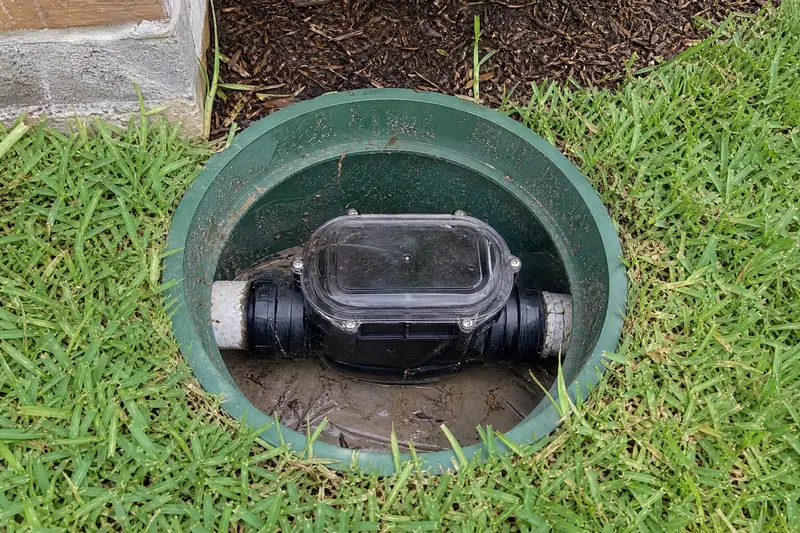
A backwater valve lets wastewater leave the house and blocks it from coming back in. FEMA's utility guide notes that the plumbing codes call these devices backwater valves and says they can help prevent wastewater backup when the municipal sanitary sewer is surcharged. The word "help" matters: a valve lowers the odds, it does not seal a house against a flood.
The problem it answers is the one in Why drains back up when the streets flood: a full public main sending sewage up the lowest fixture in the house. On a slab home that is usually a shower, tub or floor drain.
10.2 Which kind of valve is which?
FEMA's retrofitting guide names three valve types, and they differ in how they close and what they cost. Its section on sewer backflow lists check valves, gate valves and dual backflow valves and sets out the trade-offs in Table 10.1.
| Valve | How it closes | What FEMA says about it |
|---|---|---|
| Check (flap) valve | By itself, when flow reverses | Can be blocked open by debris; inspect and clean regularly |
| Gate valve | By hand | Seals better than a check valve and costs more; must be shut well before flooding |
| Dual backflow valve | Combines both | The most expensive; meant mainly for homes with repeated backflow |
| Ball float check valve | A float rises and plugs a floor drain outlet | Stops water coming up through that one drain |
FEMA's utility guide adds that sewer check valves come in sizes from 2 to 8 inches, usually with a cast-iron body and a removable cover. For the best protection, it suggests a check valve and a gate valve together.
10.3 Where does the valve go?
The valve goes on the sewer lateral, the pipe that carries waste from your house to the public main. FEMA says it should preferably sit outside the home, before the line enters the house. On City of Wharton service the standard sewer tap on a new connection is 4 inches, according to the city's service application form, a figure for new connections; an older line may differ. Neither city publishes where its part of that line ends, a gap Who fixes which pipe looks at.
There is a catch on slab houses. A valve installed on the line protects every fixture upstream of it, so the plumber has to set it where all the low drains feed through it. A floor drain that joins the line below the valve is not protected; that is where a ball float check on the drain itself can help.
10.4 What is a cleanout, and does it matter in a flood?
A cleanout is a capped fitting on the drain line that gives a plumber a way into the pipe without cutting it. In a backwater valve installation, the valve's removable cover serves the same purpose: it is how the flap is inspected and cleared.
We found no federal homeowner guidance on sewer cleanout caps as a flood entry point. FEMA's general rule for openings on equipment in a flood zone is that cleanouts and vents should sit above the protection level or be built to keep floodwater out, but that passage is about fuel tanks, not sewer lines. If your yard cleanout sits low, or its cap is cracked or missing, ask a plumber whether it should be raised or sealed.
10.5 Who installs one, and is a permit needed?
A licensed plumber installs it, under the local code. FEMA's retrofitting guide states that a licensed plumber should install any check valve system in compliance with local codes, and adds two warnings: some codes allow only dual check systems, and some municipalities prohibit backflow valves altogether.
In the City of Wharton, the Building Permits & Inspections page says the city adopted the 2018 International Plumbing Code with amendments, that contractors register with Code Enforcement, and that work needing a permit cannot start until the permit is issued. Outside city limits, ask the Wharton County Permit & Inspection Department. Plumbers in Texas are licensed by the Texas State Board of Plumbing Examiners, and Hiring a licensed plumber after a flood explains how to check one.
- Ask the city or county office whether backwater valves are allowed and which type.
- Get a licensed plumber to look at where your low drains join the line.
- Make sure the permit is issued and posted before work starts.
- Keep the paperwork with your flood records.
10.6 How do you keep a valve working?
You keep a valve working by having it looked at on a schedule, not only after a flood. FEMA's utility guide says periodic maintenance and testing is required to keep these devices working, and the retrofitting guide warns that a check valve jammed open by debris will simply fail. Grease, wipes and roots are the usual culprits in any drain line.
For new buildings, the City of Wharton's floodplain permit form requires automatic backflow devices on water and sewer connections. FEMA notes the same idea in ASCE 24, which calls for automatic backwater valves on openings below the required elevation.
Questions readers ask
Does a backwater valve stop me using my toilets during a flood?
While the valve is closed against a backed-up main, water you send down stays on your side of it. Flushing or running laundry can then fill your own pipes. Use as little water as you can until the main drains.
Can a backwater valve hurt anything?
A valve that sticks shut, or a manual valve someone forgot to open, can stop your own drains. That is one reason FEMA stresses regular inspection and testing.
Is a backwater valve the same as the backflow preventer on my water line?
No. A backwater valve sits on the sewer line and keeps sewage from coming in. A backflow preventer on the drinking-water side keeps house water from flowing back into the public supply. The City of Wharton's service agreement makes the customer install, test and maintain any backflow device its water system requires.
Can a handy homeowner fit one?
FEMA's guide says a licensed plumber should install any check valve system to local code, and in Texas that means a plumber licensed by TSBPE working under a permit. Cutting into a sewer lateral also exposes you to sewage and gas, which is another reason to leave it to the trade.
My house sits on a septic system; is a valve still useful?
FEMA says floodwater can reach a septic house through the drainfield and tank. Whether a valve suits your layout is a question for a licensed plumber and the county permitting office. The chapter on septic fields in soaked ground explains what the drainfield needs first.
What this chapter rests on
The valve types, sizes and upkeep come from FEMA's P-312 retrofitting guide (2014) and P-348 utility guide (2017); local rules come from City of Wharton permit pages, all checked 11 Nov 2026. We could not confirm whether the City of Wharton or El Campo restricts any valve type, or the exact plumbing-code sections on cleanouts.
Notes to chapter 10
- FEMA — P-312, Homeowner's Guide to Retrofitting, 3rd ed. (2014) · three valve types, check-valve debris warning, licensed plumber, local prohibitions · checked 11 Nov 2026
- FEMA — P-348, Protecting Building Utility Systems From Flood Damage (2017) · backwater valve term, placement, sizes, check plus gate, ball float, maintenance, ASCE 24, tank cleanouts · checked 11 Nov 2026
- City of Wharton — Building Permits & Inspections · 2018 IPC, contractor registration, permit before work · checked 11 Nov 2026
- City of Wharton — New Service Application / Retail Service Agreement · 4-inch sewer tap, customer backflow device duty · checked 11 Nov 2026
- City of Wharton — Floodplain Development Permit Application · automatic backflow devices on new floodplain connections · checked 11 Nov 2026
- Texas State Board of Plumbing Examiners — License Types · plumbing licence types · checked 11 Nov 2026
- TSBPE — Responsible Master Plumber · RMP pulls permits and requests inspections · checked 11 Nov 2026