Chapter 31
Slab leaks on Gulf Coast clay
The questionHow do I know if a pipe is leaking under my slab, and does the clay matter?
The short answerSlab leaks on Gulf Coast clay are hidden leaks in pipes under or within a concrete slab, and USDA soil data rates Wharton County's main soils high shrink-swell and very limited for slab houses.
By the editors of High Water at Home · Updated · about 7 minutes
Sections in this chapter
- 31.1 What soil is under a Wharton County slab?
- 31.2 What does shrink-swell mean for a slab?
- 31.3 Does the clay cause slab leaks?
- 31.4 How can you tell if water is leaking somewhere hidden?
- 31.5 Who finds and fixes a leak under the slab?
- 31.6 Does insurance treat slab leaks like flood damage?
- 31.7 Is the land itself sinking?
31.1 What soil is under a Wharton County slab?
Mostly clay and clay loam. USDA's soil survey for Wharton County, read through NRCS Soil Data Access (survey version dated 8 September 2026), maps Lake Charles clay on 0 to 1 percent slopes as the largest unit: 161,603 of about 700,474 mapped acres. Edna loam, Brazoria clay, Dacosta sandy clay loam and the Bernard-Edna complex follow.
Edna is a local soil in a literal sense. Its official series description puts the type location in Wharton County, near Hungerford, on Beaumont Formation deposits. Lake Charles clay is described as found mainly between the Colorado and Trinity Rivers, a range that takes in Wharton County.
| Soil (NRCS map unit) | Mapped acres | Highest shrink-swell, % (LEP) | Rating for dwellings on concrete slab |
|---|---|---|---|
| Lake Charles clay, 0–1% slopes | 161,603 | 13.6 | Very limited: high shrink-swell |
| Edna loam | 96,307 | 6.6 | Very limited: high shrink-swell |
| Brazoria clay | 55,142 | 17 | Very limited: high shrink-swell |
| Dacosta sandy clay loam | 51,799 | 7.2 | Very limited: high shrink-swell |
| Pledger clay | not among the five largest | 19 | Very limited: high shrink-swell |
31.2 What does shrink-swell mean for a slab?
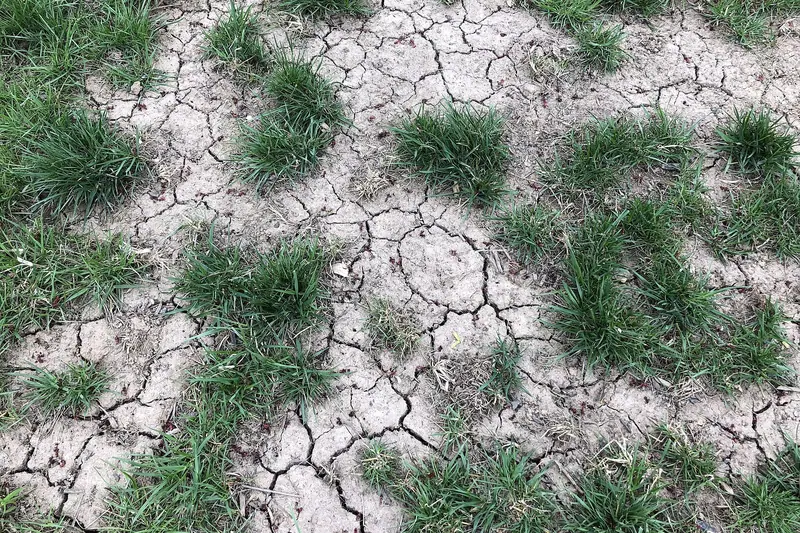
Clay that swells when wet and shrinks when dry moves what sits on it. The Lake Charles series description (revised March 2016) says that when dry, the soil opens cracks 1/2 to 2 inches wide at the surface that reach 12 inches or deeper, and that in most years they stay open 60 to 90 days. Water pours in while the cracks are open, but very slowly once the soil is wet and they close.
Dacosta soils crack 0.4 to 2 inches wide and more than 20 inches deep when dry, and water perches on them for 1 to 2 weeks after long, heavy rains. A dry Wharton County summer followed by a tropical storm can put a slab through both conditions in a few weeks.
NRCS ratings like "very limited" are for planning. They describe the soil, not any one house, and they do not say a given slab will crack or leak.
31.3 Does the clay cause slab leaks?
Nobody has published that link for this county. We found no agency figure tying a share of slab leaks to clay soils, so this book does not claim one. What the soil data does show is that the ground under most Wharton County slabs moves more than average, and that it is rated hard on buried metal.
NRCS rates the risk of corrosion to uncoated steel as high in Lake Charles, Edna, Brazoria, Dacosta and Pledger soils, and the risk to concrete as low to moderate. That rating is about bare steel in contact with soil, not copper or plastic pipe.
31.4 How can you tell if water is leaking somewhere hidden?
Read your meter. EPA's WaterSense program gives a simple meter test (page updated 13 March 2026):
- Rule out toilets first: put a few drops of food coloring in the tank and wait 10 minutes. Color in the bowl means the flapper leaks.
- Pick a two-hour stretch when nobody will use water, inside or out.
- Write down the meter reading at the start.
- Read it again at the end. If it has moved at all, you probably have a leak.
EPA adds that a family of four using more than 12,000 gallons a month in winter probably has a serious leak somewhere. The meter on a City of Wharton service marks where the city's description of the customer's side begins; who fixes which pipe explains that line.
A moving meter does not tell you the leak is under the slab. It could be a yard line, a faucet or an irrigation valve; finding it is the plumber's job.
31.5 Who finds and fixes a leak under the slab?
A licensed plumber, with a permit where one is required. In Texas that means someone licensed by the Plumbing Board, working under a Responsible Master Plumber. Wharton's Code Enforcement Department keeps a register of contractors and issues permits before work begins; on county lots, the Wharton County Permit & Inspection Department on East Milam Street handles permits. Hiring a licensed plumber after a flood walks through the checks, and they apply just as well in dry weather.
31.6 Does insurance treat slab leaks like flood damage?
No. A flood policy is for flooding, and FEMA's Dwelling Form leaves out a supply or sewer line that simply breaks or fails when that was within your control. Whether a homeowner's policy pays for a slab leak depends on that policy; ask your agent. Flood insurance and plumbing damage lays out what the flood policy does cover.
31.7 Is the land itself sinking?
In places, over decades of pumping. TWDB's Gulf Coast Aquifer page, which shows no date, names Wharton among the counties where groundwater levels fell by as much as 350 feet and land subsided. Back in 1982, Report 270 measured the greatest sinking across its three-county study area at less than 1 foot.
Those are separate figures from separate years, and neither links subsidence to any particular slab. They are background for why the ground here is not as still as it looks. The same clay that moves under slabs also drains poorly; NRCS rates Lake Charles clay very limited for septic drainfields, which ties into septic systems in soaked ground.
Questions readers ask
Do warm spots on the floor mean a hot-water slab leak?
None of the agency pages cited here list warning signs for slab leaks. The meter test is the published first step; a licensed plumber can locate the source.
Is a pier-and-beam house safer from this than a slab?
The NRCS ratings cited here are for dwellings on concrete slab, and this chapter did not check ratings for other foundations. Raised houses carry their own flood and freeze risks, covered in chapter 12.
How much water does a typical household leak waste?
EPA says the average household's leaks waste more than 9,300 gallons a year. A slab leak on a pressurized line can run all day, which is why the meter test is worth repeating now and then.
Can the city tell me if my usage jumped?
Your bill shows monthly use, and a jump with no change in habits is a reason to run the meter test. The City of Wharton's Water/Sewer Department can confirm a meter reading.
Does watering the foundation in a drought help?
We have no agency guidance on foundation watering for Wharton County soils, so this chapter makes no recommendation. A structural engineer is the right person to ask about a particular foundation.
What this chapter rests on
The soil facts are USDA NRCS survey data for Wharton County (version of 8 Sep 2026) and NRCS series descriptions; the leak test is EPA WaterSense's; subsidence figures are TWDB's, from its aquifer page and 1982 Report 270; all checked on 11 Nov 2026. An AgriLife bulletin on foundations over expansive clay could not be found on an AgriLife site, and no source here gives warning signs of slab leaks beyond the meter.
Notes to chapter 31
- USDA NRCS — Soil Data Access, survey area TX481 Wharton County · map-unit acres, slab ratings, LEP, corrosion, septic ratings · checked 11 Nov 2026
- USDA NRCS — Official Series Description, Lake Charles (rev. March 2016) · cracking, water entry, range · checked 11 Nov 2026
- USDA NRCS — Official Series Description, Edna (rev. August 2016) · Wharton County type location, Beaumont Formation · checked 11 Nov 2026
- USDA NRCS — Official Series Description, Dacosta · cracks, perched water after rain · checked 11 Nov 2026
- US EPA WaterSense — Fix a Leak Week · two-hour meter test, toilet dye test, 12,000 and 9,300 gallon figures · checked 11 Nov 2026
- Texas State Board of Plumbing Examiners — License Types · plumbing licenses · checked 11 Nov 2026
- City of Wharton — Building Permits & Inspections · contractor registration and permits · checked 11 Nov 2026
- FEMA — Standard Flood Insurance Policy, Dwelling Form F-122 (October 2021) · line breakage exclusion · checked 11 Nov 2026
- Texas Water Development Board — Gulf Coast Aquifer · water-level declines and subsidence · checked 11 Nov 2026
- Texas Water Development Board — Report 270 (July 1982) · subsidence under 1 foot in 1982 · checked 11 Nov 2026