Chapter 19
Softeners, filters and treatment units after a flood
The questionCan my water softener or whole-house filter be cleaned and used again after a flood?
The short answerA water softener or filter that floodwater reached usually needs its media or cartridges thrown out, its tank and valve sanitized by the maker's method, and its electrical head kept off until it is dry and checked.
By the editors of High Water at Home · Updated · about 8 minutes
Sections in this chapter
- 19.1 Can a softener or filter that sat in floodwater be saved?
- 19.2 What about the control head and the plug?
- 19.3 Why put treatment equipment on bypass?
- 19.4 What happens to cartridges, resin and membranes?
- 19.5 Who sanitizes a softener, and how is it done?
- 19.6 Does a filter make flood-season tap water safe to drink?
- 19.7 Is a softener covered by flood insurance?
19.1 Can a softener or filter that sat in floodwater be saved?
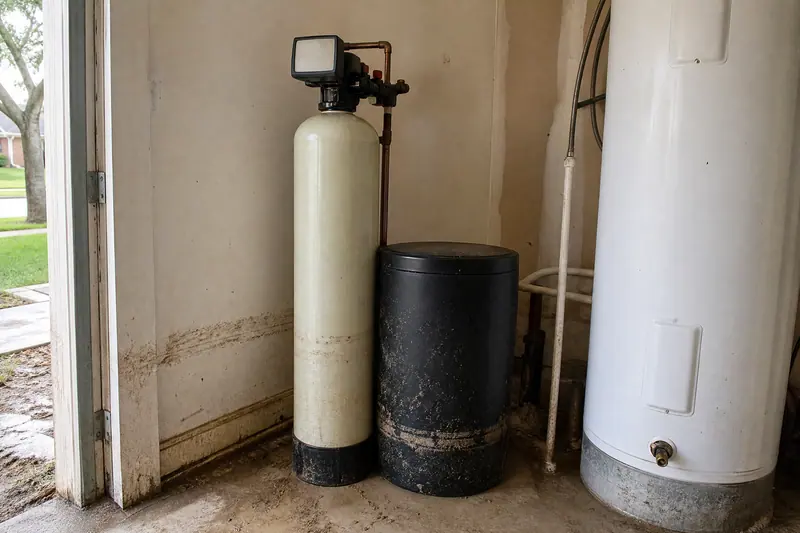
The tank and valve often can; what is inside usually cannot. The Water Quality Association's sanitizing guidance, updated July 30, 2020, says that when raw sewage or heavily contaminated water has reached the resin bed or media, as in a flooded well, no attempt should be made to clean it. The resin or media comes out and goes in the trash, the tank and control valve are sanitized, and new media goes in.
Floodwater in Wharton County is rarely clean. It carries field runoff from rice country, street water and, in town, whatever backed out of the sewers. Treat any unit it touched as contaminated, whether it sits in a garage in El Campo or under a carport outside Boling.
19.2 What about the control head and the plug?
It stays unplugged and unused until it is completely dry and checked. Many softeners and backwashing filters have an electric control head on top. WQA's 2013 education kit on sanitizing water-using appliances says that if an appliance was partly or fully under water, its electrical parts must be completely dry first.
Do not reach for the plug if the outlet, the cord or the floor around it is wet. Anything electrical that was under water, including the outlet itself, stays off until a licensed electrician says otherwise. Power stays off explains why breakers and outlets that were submerged are replaced rather than dried.
19.3 Why put treatment equipment on bypass?
Bypass keeps strong chlorine and dirty water out of the unit while the rest of the system is cleaned. AgriLife's shock chlorination guide puts softeners and filters on bypass as an early step, and ends by telling owners to disinfect them following the maker's directions. CDC's well disinfection page warns that the large amount of chlorine used can damage water softeners.
The bypass is a water valve or set of valves at the unit, not anything to do with gas or power. FEMA's 2017 utility guide recommends bypass valves on treatment equipment that is not protected from floods, so a damaged unit can be cut out of the house water. If your unit has none, a licensed plumber can add one. Disinfecting a flooded well covers the well side of that job.
19.4 What happens to cartridges, resin and membranes?
Most of them are replaced. Table 19.1 sums up what the guidance says for each kind of unit.
| Equipment | What the guidance says | Source |
|---|---|---|
| Softener resin reached by floodwater | Do not clean it; remove, discard and replace | WQA (2020) |
| Carbon or sediment cartridge filter | Remove and discard the cartridge, then sanitize the housing | WQA (2020) |
| Reverse osmosis unit | Discard prefilter and postfilter cartridges; ask the maker about the membrane | WQA (2020) |
| Whole-house cartridge units after an advisory | Change the cartridges; some units need disinfecting; follow the manual | CDC (2016) |
| Softener during well shock chlorination | Bypass it; chlorine can damage it | CDC (2025) |
| Electric control head | Must be completely dry before use | WQA kit (2013) |
WQA also warns that high chlorine levels can wear out O-rings, ion-exchange resin and some reverse osmosis membranes. That is one more reason to follow the maker's procedure, not a homemade bleach dose. CDC's 2016 drinking water advisory toolbox adds that a softener may need a regeneration cycle after an advisory.
19.5 Who sanitizes a softener, and how is it done?
The maker's instructions come first. WQA says that when a manufacturer gives detailed sanitizing steps, those steps should be followed instead of WQA's general ones. Its own guidance is written for water treatment professionals, so a dealer or licensed plumber is the usual choice for a unit that floodwater reached.
After any chlorine sanitizing, WQA says to flush water through the equipment until the chlorine drops below 1 part per million, or to the level in the incoming water. A dealer will usually test for that with a kit. Ask for the result when the job is done.
- Leave the unit on bypass and unplugged.
- Find the manual or the model number on the tank or control head.
- Ask the maker or dealer whether the resin or media must be replaced.
- Have the tank and valve sanitized by the maker's method.
- Put in new cartridges, resin or media as required.
- Flush, then return the unit to service only after any well work and lab tests are done.
19.6 Does a filter make flood-season tap water safe to drink?
No. During a boil-water notice, CDC says to boil tap water even if you filter it, including water from a home filter or a filter pitcher. A softener is not on any agency list of ways to make unsafe water safe.
If you are on the City of Wharton's system or another public supplier, the utility's notice tells you when the water is safe again; see Is the tap water safe after a flood?. If you are on a private well, a lab test decides it, as Testing well water after a flood explains.
19.7 Is a softener covered by flood insurance?
Under a raised house, it is named. FEMA's Dwelling Form, dated October 2021, names water softeners, their chemicals, and filters and faucets that are part of the plumbing system among the few items covered below the lowest elevated floor or in a basement. That was the form posted on FEMA's site when this chapter was checked on 11 Nov 2026.
Take photos of the unit, the model plate and the water line on the wall before anything is hauled away. Your adjuster decides the claim. Flood insurance and plumbing damage has more on the policy.
Questions readers ask
Can the salt in the brine tank be reused after the flood?
Treat it like the resin: if floodwater got into the brine tank, ask the maker how to empty and sanitize it, and whether any of the salt can be kept. Keep the unit on bypass until then.
My softener was above the water line but the well flooded. Does it still need work?
Probably. WQA's guidance covers resin reached by highly contaminated water from a flooded well, not just units that sat in the flood. Keep it on bypass until the well is disinfected and tested, then follow the maker's sanitizing steps.
Should the unit be left on bypass while a boil-water notice is in force?
Ask the maker. CDC's advisory toolbox says a softener may need a regeneration cycle after the notice is lifted, and whole-house cartridges should be changed. Until then, boil any water you drink, filtered or not.
Is a reverse osmosis faucet under the sink safe to use after a boil notice?
Not until its prefilter and postfilter cartridges are replaced and the system is sanitized, as WQA describes. Check with the maker about the membrane, since strong chlorine can damage some membranes.
Who can install a replacement softener inside city limits?
Plumbing work in the City of Wharton goes through Code Enforcement, which asks contractors to register with their state license. Check the license on the Texas State Board of Plumbing Examiners lookup before work starts.
What this chapter rests on
This chapter draws on the Water Quality Association's 2020 sanitizing guidance and 2013 education kit, CDC's advisory toolbox and well disinfection pages, AgriLife's shock chlorination guide, FEMA's utility guide and Dwelling Form, and a 1982 state groundwater report, checked on 11 Nov 2026. WQA's documents are written for professionals, so dose figures are left out. No maker's flood statement for any softener brand was found, so the maker's manual for your model is the final word.
Notes to chapter 19
- Water Quality Association — Guidance for Sanitizing Residential Drinking Water Treatment Systems (2020) · discard contaminated resin and cartridges, maker's procedure first, flush below 1 ppm, chlorine damage to O-rings and resin, not for raw sewage · checked 11 Nov 2026
- Water Quality Association — Sanitizing Water-Using Appliances in Water Emergencies (2013) · electrical parts completely dry before use · checked 11 Nov 2026
- CDC — How to Disinfect Wells After an Emergency · chlorine may damage softeners, close softener valves · checked 11 Nov 2026
- CDC — Drinking Water Advisory Communication Toolbox (2016) · regeneration cycle, change cartridges after an advisory · checked 11 Nov 2026
- CDC — Drinking Water Advisories: An Overview · boil even if filtered · checked 11 Nov 2026
- Texas A&M AgriLife Extension — ESC-059, How to Disinfect a Water Well Through Shock Chlorination (2019) · bypass softeners and filters, disinfect per maker · checked 11 Nov 2026
- FEMA — P-348, Protecting Building Utility Systems From Flood Damage (2017) · bypass valves to isolate treatment equipment · checked 11 Nov 2026
- FEMA — NFIP Dwelling Form F-122 (2021) · softeners and filters covered below elevated floors · checked 11 Nov 2026
- Texas Water Development Board — Report 270, Ground-Water Resources of Colorado, Lavaca, and Wharton Counties (1982) · regional hardness of about 425 samples · checked 11 Nov 2026
- City of Wharton — Building Permits & Inspections · contractors register with Code Enforcement · checked 11 Nov 2026