Chapter 24
Cleaning sinks, tubs, toilets and drains
The questionHow do I clean my sinks, tub and toilet after floodwater got into the house?
The short answerCleaning sinks, tubs and toilets after a flood starts with soap and warm water, then CDC's mix of 1 cup of bleach to 5 gallons of water, with windows open, gloves on, and no other cleaner anywhere near the bleach.
By the editors of High Water at Home · Updated · about 7 minutes
Sections in this chapter
- 24.1 What bleach mix does CDC give for sinks, tubs and toilets?
- 24.2 Why must bleach never meet another cleaner?
- 24.3 Which items go to the curb?
- 24.4 When can water go down the drains again?
- 24.5 How do you clean a toilet, tub or sink that floodwater filled?
- 24.6 What about fans, shop vacs and drying out the room?
- 24.7 When should a licensed plumber take over?
24.1 What bleach mix does CDC give for sinks, tubs and toilets?
For hard surfaces that touched floodwater, 1 cup of bleach to 5 gallons of water. CDC's page on cleaning with bleach, updated January 23, 2024, lists floors, sinks, certain toys and tools in that group. Clean first with soap and warm water, then sanitize with the bleach mix.
CDC uses different strengths for other jobs, and it helps to keep them apart. Table 24.1 lists them.
| Job | Mix | Notes |
|---|---|---|
| Hard surfaces that touched floodwater: sinks, tubs, floors, tools | 1 cup (240 mL) bleach to 5 gallons of water | Wash with soap and warm water before sanitizing |
| Food-contact surfaces: counters, plates | 1 tablespoon bleach to 1 gallon of water | Sanitize after washing |
| Mold on hard surfaces | 1 cup bleach to 1 gallon of water | Scrub rough surfaces with a stiff brush, rinse, air-dry |
| Food cans that sat in floodwater | 1 cup bleach to 5 gallons of water | Dip the cans |
Use regular, unscented household bleach with a sodium hypochlorite strength between 5 and 9 percent, as CDC specifies. Hard surfaces that sewage from a septic backup touched take the same 1-cup-to-5-gallons mix; A flooded septic system covers the rest of that job.
24.2 Why must bleach never meet another cleaner?
Because CDC allows no exception: bleach goes with water and nothing else, ammonia above all. That includes toilet bowl cleaners, glass cleaners, drain openers and the half-used bottle of whatever was under the sink. If you have already poured a drain product into a sink or toilet, flush it away with plain water before any bleach goes near it.
Open windows and doors when you use bleach indoors, CDC adds. In a closed-up house in August heat near El Campo, the air can be thick with mold and bleach smell. Wear rubber or other non-porous boots, gloves and eye protection.
Ready.gov's flood page keeps children out of cleanup work altogether. Keep them and pets out of the rooms until the work is done and the bleach is rinsed and dry.
24.3 Which items go to the curb?
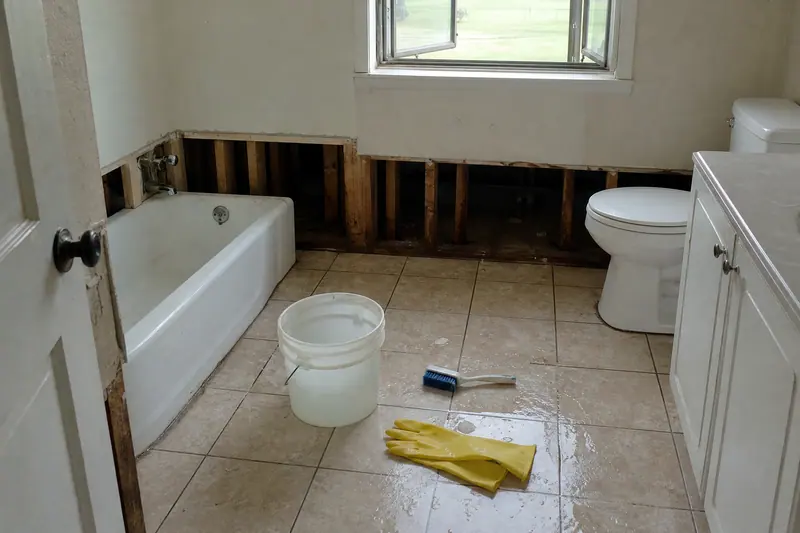
Anything that soaks up water and cannot be disinfected. CDC's floodwater safety page names wall coverings, cloth, rugs and drywall. In a bathroom that usually means bath mats, shower curtains made of cloth, towels you cannot hot-wash, and the drywall behind a vanity that sat in water.
Hard fixtures are a different matter. Porcelain, enamel and glazed tile do not soak up water, so they fall under CDC's hard-surface mix. Cracked, chipped or loose fixtures are a job for a licensed plumber, as are faucets that will not shut off cleanly after the mud is out of them.
24.4 When can water go down the drains again?
That depends on where the drains go. If you are on a city sewer in Wharton or El Campo, the sewer itself may still be full. FEMA's 2017 utility guide notes that sewage can back up into a house even when the house did not flood, because most wastewater systems run on gravity. If the streets are still under water, wait; the chapter on drain backups explains the reason.
If you are on septic, the EPA's questions on flooded homes tell owners to wait until the water in the absorption field is lower than the floodwater around the house. In both cases, clean with a bucket and sponge rather than a running tap, which keeps the water going down the drains to a minimum until they are safe to use.
24.5 How do you clean a toilet, tub or sink that floodwater filled?
In the same order every time. Work from the top of each fixture down and from the cleanest part of the room to the dirtiest.
- Put on gloves, boots and eye protection, and open the windows.
- Scoop or sponge out standing water and mud into a bucket.
- Wash every surface with soap and warm water, including the outside of the toilet tank, the base and the floor around it.
- Sanitize with the CDC mix of 1 cup of bleach to 5 gallons of water.
- Rinse with clean water and let everything air-dry.
- Wash your hands with soap and clean water, or use alcohol-based wipes or sanitizer if you have none, as CDC advises.
Wash work clothes that touched floodwater or sewage in hot water and detergent before wearing them again, CDC says. Keep cuts covered with a waterproof bandage while you work.
24.6 What about fans, shop vacs and drying out the room?
Use them only once power is safe. CDC's reentry guidance says fans belong at a window or door blowing air outward, so they do not spread mold through the house, and suggests dehumidifiers. A wet-dry shop vac or pump goes on only after an electrician says the power is safe: plug it in only at a dry, GFCI-protected outlet a licensed electrician has cleared, keep the cord and plug out of water, and never stand in water while it runs.
Outlets, cords and panels that were under water stay switched off until a licensed electrician has checked them; Power stays off covers why. Gasoline pumps and pressure washers stay outside, never in a garage, carport or porch, and at least 20 feet clear of any door, window or vent, the distance CDC's reentry page sets.
24.7 When should a licensed plumber take over?
When the problem is inside the pipes, not on the surface. A drain that stays slow after cleaning, a toilet that rocks on its base, a faucet that drips or will not close, or water around the base of a tub all point to work beyond a sponge. In the City of Wharton, contractors must register with Code Enforcement and pull permits for work that needs one; you can look up any plumber in the state board's public search. Hiring a licensed plumber after a flood has more on estimates and scams.
Questions readers ask
Can the faucet aerators be cleaned and put back?
Unscrew them and wash out the silt, then soak in the CDC hard-surface mix and rinse. If the screen is torn or the threads are damaged, replace it.
Is vinegar or a scented cleaner safer than bleach?
CDC's flood guidance is written around unscented bleach for sanitizing. Whatever you use, do not mix it with bleach, and do not follow one with the other without rinsing in between.
Should the toilet tank be emptied and cleaned inside?
If floodwater reached the tank, yes: sponge it out, wash it with soap and water, then sanitize and rinse. If the fill valve or flapper is caked with mud and will not work, have it replaced.
Can dishes be washed in the sink once it is sanitized?
Only if your water is safe to use. If a boil-water notice is in force, follow it; the tap water chapter covers hand-washing dishes during one.
How long should the windows stay open?
Long enough that the bleach smell clears and the room dries. CDC's minimum for airing out a closed-up flooded house before staying is 30 minutes; drying out the room itself takes longer.
What this chapter rests on
This chapter is built on CDC's bleach cleaning page, floodwater safety page and reentry guidance, the EPA's flooded homes questions, FEMA's utility guide, Ready.gov's flood page, the City of Wharton's permit page and the TSBPE license lookup, checked on 11 Nov 2026. CDC uses more than one bleach strength depending on the job, so each one is named with its use. We found no agency guidance on reusing specific bathroom fixtures, so that call is left to a licensed plumber.
Notes to chapter 24
- CDC — How to Safely Clean and Sanitize with Bleach · bleach mixes by job, 5 to 9 percent bleach, never mix cleaners, gear, ventilation · checked 11 Nov 2026
- CDC — Safety Guidelines: Floodwater · items to throw away, hand hygiene, washing clothes, wounds · checked 11 Nov 2026
- CDC — Reentering Your Flooded Home · assume mold, air out 30 minutes, fans outward, shop vacs after an electrician, gasoline engines outdoors · checked 11 Nov 2026
- US EPA — Frequent Questions about Flooded Homes · septic use after a flood · checked 11 Nov 2026
- FEMA — P-348, Protecting Building Utility Systems From Flood Damage (2017) · sewage backup without house flooding · checked 11 Nov 2026
- Ready.gov — Floods · children out of cleanup · checked 11 Nov 2026
- City of Wharton — Building Permits & Inspections · contractor registration and permits · checked 11 Nov 2026
- Texas State Board of Plumbing Examiners — Find a License / Registration · checking a plumber's license · checked 11 Nov 2026