Chapter 6
The wellhead before a storm
The questionWhat should I do to my water well before a flood or hurricane?
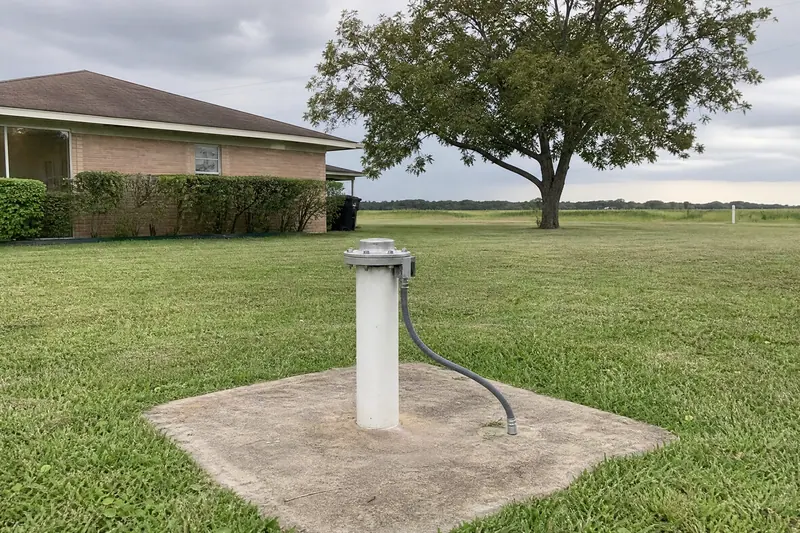
The short answerThe wellhead before a storm needs a tight sanitary cap, a casing that stands above past flood levels and clear ground around it, because floodwater that gets in at the top reaches the water you drink.
By the editors of High Water at Home · Updated · about 7 minutes
Sections in this chapter
6.1 Why does the wellhead matter in a flood?
The casing is a straight pipe from the surface to the aquifer, and anything that gets in at the top travels down it. The Texas Well Owner Network's answer on flood-prone wells says to make sure the well is cased above past flood levels and that floodwater cannot seep in through the top of the wellhead or the cap. The Texas Department of Licensing and Regulation calls abandoned and failing wells "direct conduits" to groundwater, and a leaky cap on a working well acts much the same.
Wells set inside pits are at extra risk. AgriLife's 2006 guide to flooded wells notes that a well in a pit can flood even when the ground around it is not under water.
6.2 How high should the casing stand?
Above any flood you have seen, and higher still in a known flood area. AgriLife's ESC-058, dated September 2019, says to case the wellhead above any previous flood level and that you will likely need a licensed well driller to do it.
For wells in flood-prone places, AgriLife's 2015 bulletin Water Wells in Floodplains (ERM-014) quotes the state well rule, 16 TAC 76.100(a)(5): a watertight sanitary seal, plus a steel sleeve reaching at least 36 inches above ground and 24 inches below it. This book could not confirm the rule's current wording; ask a licensed driller what applies to your well.
6.3 What can you check from the outside?
You can look without opening anything. The EPA's private well page, updated 26 Feb 2026, lists the warning signs (Table 6.1). Walk out with a flashlight a few weeks before the season and note what you see.
| Part | What to look for | Source |
|---|---|---|
| Casing | Cracks, rust, dents; casing cut off below ground | EPA |
| Cap or sanitary seal | Missing, broken or loose | EPA |
| Surface seal and pad | Settling, cracks, gaps at the casing | EPA, AgriLife |
| Ground slope | Low spots where runoff pools at the well | EPA |
| Pit (if any) | Water collected inside after rain | AgriLife |
ESC-058 says cracks in a concrete pad can be repaired with bentonite or cement. It also warns that a crack below ground may show up only as fecal coliform or E. coli in a water test, which is a job for a licensed driller to trace. If the cap or casing looks wrong, call one before storm season rather than after.
6.4 What must be kept away from the well?
Texas sets minimum distances between a well and things that can foul it. AgriLife's May 2023 Water Well Basics lists them, and TDLR's own page gives the same septic figures (Table 6.2).
| Keep this far away | Distance |
|---|---|
| Septic tank, cistern, property line, or a nonpotable well | 50 ft |
| Septic drainfield or any leach field | 100 ft |
| Feed, pesticide or fertilizer storage; animal pens | 150 ft |
| Manure stack or liquid waste disposal | 250 ft |
On a rice-country lot with a barn and a shop, those distances matter before a storm. Move fuel cans, weed killer, fertilizer and degreasers well away from the wellhead and onto high, dry shelving, as the EPA advises. Slope the dirt so rain runs away from the casing, not toward it.
6.5 What about an old well nobody uses?
Get it plugged or capped properly. Under TDLR's guidance on abandoned wells, plugging an unused or failing well falls to whoever holds title to the land, and the plugging report is due within 30 days after the work. Until it is plugged, the old well needs a covering strong enough to bear 400 pounds, tight enough to stop surface pollution, and hard to pull off by hand. The rule allows a landowner to do the plugging, but this book leaves work inside any casing to licensed drillers and pump installers.
6.6 What goes in the go-bag for the well?
Paper first. ESC-058 says to keep a copy of the well log, the report made when the well was drilled, with your evacuation papers. If you cannot find it, the local groundwater conservation district or the Texas Water Development Board's groundwater data viewer may hold a copy.
Then water. ESC-058 treats a well that floods for even a few minutes as unfit for drinking, cooking or brushing teeth until it is cleaned and tested, so put bottled water by the door; chapter 4 gives amounts. AgriLife also lists supplies for disinfecting the well afterward, but it strongly recommends hiring a licensed driller for a flooded well; the disinfection chapter explains why. Ask an accredited lab for sterile sample bottles now, while the roads are dry.
Before you leave, ESC-058 says to fill the pressure tank and cut power to the well. Do that only from a dry spot, as the generator chapter explains. If the pump or its controls go under, the chapter on well pumps covers what comes next, and testing well water covers the lab.
Questions readers ask
Can the old steel cap stay if it still fits?
If it is unbroken, sits tight and keeps out water and insects, it may be fine. If it is rusted through, loose or missing its seal, have a licensed driller or pump installer replace it before the season.
Does a well in a shed or pump house need the same care?
Yes. A pump house keeps rain off, but floodwater still rises inside it. The same checks on cap, casing and pad apply, and chemicals stored in the shed count toward the distance rules.
Is water from an old, unused well on the place safe to drink?
Not without a lab test. An old well with a poor cap or cracked casing can carry surface water straight down, and TDLR treats deteriorated wells as a hazard to groundwater.
Will raising the casing change my water?
The casing extension is about keeping floodwater out at the top. A licensed driller can tell you whether any other work is needed on your well.
Where is the depth of the well written down?
The well log, if you have it, records the depth. If not, the groundwater district or the state's groundwater data viewer may hold the driller's report.
What this chapter rests on
This chapter leans on AgriLife and Texas Well Owner Network guides from 2006, 2015, 2019 and 2023, the EPA's private well page (updated 26 Feb 2026) and TDLR's undated well pages, checked on 11 Nov 2026. The casing figures are as AgriLife quoted the state rule in 2015 and may have changed since.
Notes to chapter 6
- Texas Well Owner Network — Frequently Asked Questions · flood-prone wells, casing above flood levels, cap seepage · checked 11 Nov 2026
- Texas A&M AgriLife Extension / TWON — How to Ready Your Well for the Next Flood (ESC-058, Sept 2019) · casing height, pad repair, well log, bottled water, pressure tank, licensed driller · checked 11 Nov 2026
- Texas A&M AgriLife Extension — Water Wells in Floodplains (ERM-014, March 2015) · 16 TAC 76.100(a)(5) seal and sleeve · checked 11 Nov 2026
- US EPA — Protect Your Home's Water · inspection items, slope, chemicals, casing below ground · checked 11 Nov 2026
- Texas A&M AgriLife Extension — Water Well Basics (SCSC-PU-137, May 2023) · minimum distances · checked 11 Nov 2026
- TDLR — Technical Guidance on Abandoned or Deteriorated Water Wells · landowner responsibility, 30-day report, 400-pound cap · checked 11 Nov 2026
- TDLR — Water Well Drillers and Pump Installers · license requirement · checked 11 Nov 2026
- Texas A&M AgriLife Extension — Decontaminating Flooded Wells (ER-011, June 2006) · wells in pits · checked 11 Nov 2026
- CDC — How to Disinfect Wells After an Emergency · do not enter the well pit · checked 11 Nov 2026